
Voter Lists from the Antoni Schneider Collection
Project Coordinator: Yaron Wolfsthal
Voter Lists from the Antoni Schneider Collection
Project Coordinator: Yaron Wolfsthal
Background
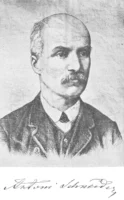 Antoni Schneider (1825–1880) was an ethnographer whose life was consumed by a monumental obsession to document the “cultural fabric” of Galicia. While serving a three-year sentence for participating in the 1848 Hungarian uprising, he developed a visionary plan: the creation of a definitive encyclopaedia of his homeland Galicia. To this end, Schneider scoured paper mills and antique shops, building an extensive archive of documents on Galicia. Despite his zeal, financial instability and a lack of subscribers led to the publication of only two volumes. In 1876, acknowledging his inability to finish the work, Schneider agreed to donate the materials to the newly established Academy of Arts and Sciences in exchange for an annual salary. This transaction ensured the survival of approximately 2000 folders and 95,000 cards of primary source material, which now serve as an archival bridge to unique 19th-century data that escaped the mainstream of historical record-keeping.
The Schneider collection, now split between repositories in Krakow and Lviv, contains records of demographic, regional, economic, religious, social, administrative and legal nature, among others. In particular, the files consist of documents containing Jewish names, Hebrew signatures, reports on the social and religious status of Jewish communities, and royal privileges granted to Jewish residents in specific towns. All in all, the collection offers rare insights into small towns and Jewish communities.
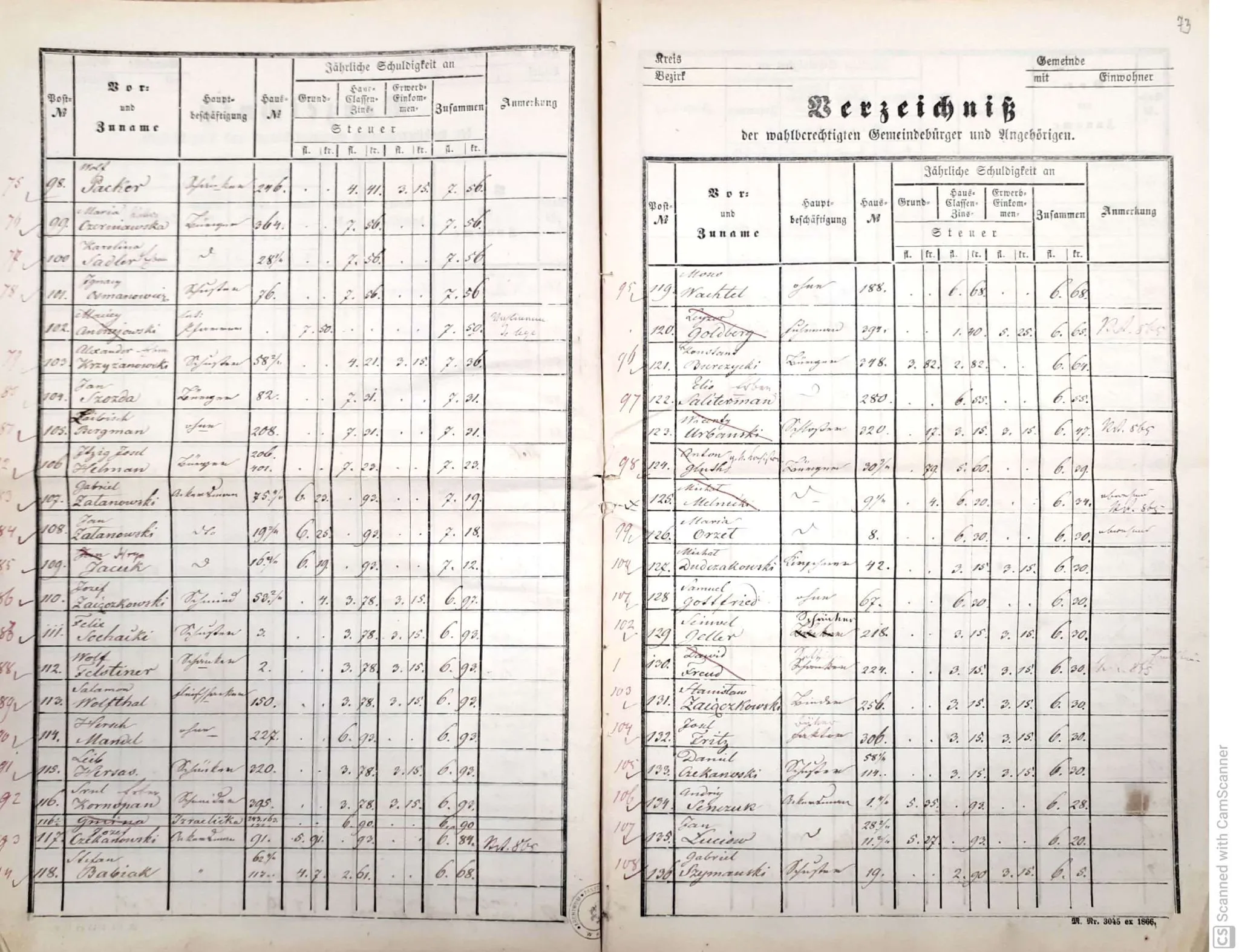
This project focuses on the voter lists found in the Antoni Schneider collection held at the Krakow National Archive. These are detailed records of residents eligible to vote in parliamentary elections for the Galician Sejm (parliament). These documents primarily date from the 1860s and 1870s, with specific lists identified from 1861, 1867 and 1870. These lists typically record the names, occupations, and house numbers of eligible individuals. It is important to note that these lists do not represent the entire population. During this period in Galicia (1860-1870), only a small percentage of residents were permitted to vote – primarily male heads of families who paid significant taxes.
Archival Resource information
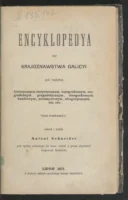 The primary archival unit containing the materials Antoni Schneider gathered for his ill-fated encyclopaedia is Fond 684, physically held at the new location of National State Archives in Krakow. It is titled “Teki Antoniego Schneidra” (Antoni Schneider’s Files). This fond is massive, containing thousands of individual files. It is partly accessible online to remote researchers via the Polish national archive website (szukajwarchiwach.gov.pl); as of early 2026, over 87,000 digital scans from this fond were made available online. Access to this collection via the Polish national archive website is improving, but the approach of Gesher Galicia is to independently digitize and index the files of interest to our community, in order to minimize the dependency on factors beyond our control. The fond is organized based on keywords (hasła) or specific geographical ranges. These include, among others, files dedicated to specific cities and towns, such as Drohobycz, Krakow, Lwow, Belz, and Wadowice. Large towns may have multiple dedicated files (e.g., “Drohobycz II”). The Voter Lists are stored in these files.
The collection has been mirrored at the Central Archive for History of the Jewish People in Jerusalem and has been partly indexed in the Judaica Catalogue accessible online on the website of the Jagiellonian University. Information about the Schneider collection has been previously published by genealogists. Of note is the index published by Russ Maurer and scans taken by Logan Kleinwaks (see acknowledgments section below).
Benefits to Researchers
The voter lists within the Schneider collection provide specific demographic insights into mid-to-late 19th-century Galicia and Bukovina. While these lists do not represent the entire population, the data included in the lists is an important substitute for missing census records and can be also used to cross-reference with other resources such as vital records and tax lists which researchers may have from other sources. For example,
Pinpointing Ancestral Residences: The house numbers found in some voter lists allow researchers to cross-reference data with cadastral surveys and vital records to locate the exact plot of land an ancestor inhabited.
Socio-Economic Profiling: Understanding an ancestor’s eligibility to vote for the Sejm, alongside their listed occupation, provides insight into their tax status and social standing, especially with the occupation.
Insights into weakly-documented locations: Schneider documented locales that often lack their own archival fonds, preserving the only surviving evidence of their 19th-century residents.
Timeline and Acknowledgements
The project started in early 2026. Voter lists from Gliniani and Rohatyn have been indexed, and we expect a decent deal of work to be completed by the end of 2028. The results of the project will be uploaded, after verification, to the All Galicia Database and will be accessible through the search engine. A group of people has been involved, now and previously, and we would like to thank each one of them:
- Russ Maurer: For his field work at the Wawel branch (previous home of the collection), where he photographed the physical index and shared insightful information about the collection with the global JewishGen community.
- Logan Kleinwaks: For his field work at the Wawel branch, where he photographed over a dozen files, and his expert guidance about the collection and navigating it via the Judaica Catalogue.
- Idan Livne: For his excellent work indexing the voter lists and helping to identify subtle inconsistencies and gaps in the lists.
- Alex Feller: For his pioneering work on indexing the Rohatyn voter lists.
- Yoav Mentesh: For his help resolving complex naming challenges.
For a list of the towns for which voter lists have been indexed, please look at the Gesher Galicia Record Inventories page (link to https://www.geshergalicia.org/
Check other projects
The Holocaust Project
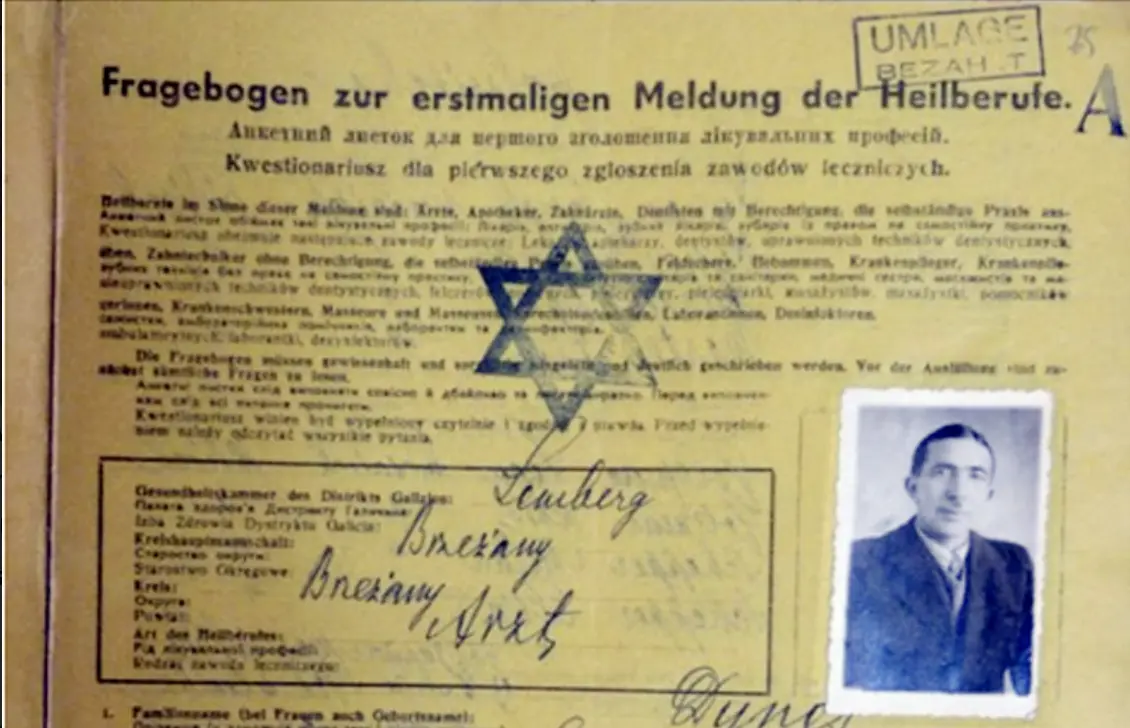
The Holocaust Project is concerned with events in the territory of the former Galicia during the period 1939-1945, particularly those with genealogical and historical information about the Jewish inhabitants of the region. Apart from state archive branches, municipal offices, museums, libraries, universities and research institutes in Poland and western Ukraine, there is also much information […]
Read more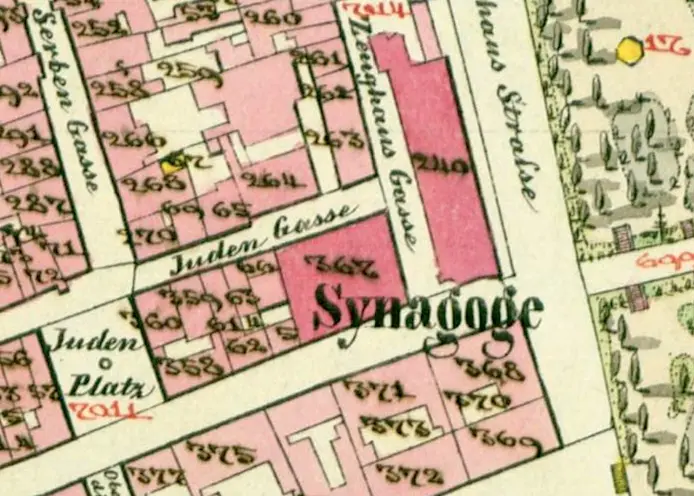
Become a member
Become a member starting at $50 per year
Become a member starting at $50 per year Member benefits include a subscription to The Galitzianer, our quarterly research journal; access to Family Finder to share your family surnames and towns and network with other members; webinars and podcasts; and more!